Product deep dive
SlateHut: The AI Website Builder I Trust for Real, Multi-Page Sites
Hands-on look at SlateHut (slatehut.com): AI site generation, visual editing, forms, CMS, custom domains, REST API, and MCP, why it is my pick for the best AI website maker in 2026.
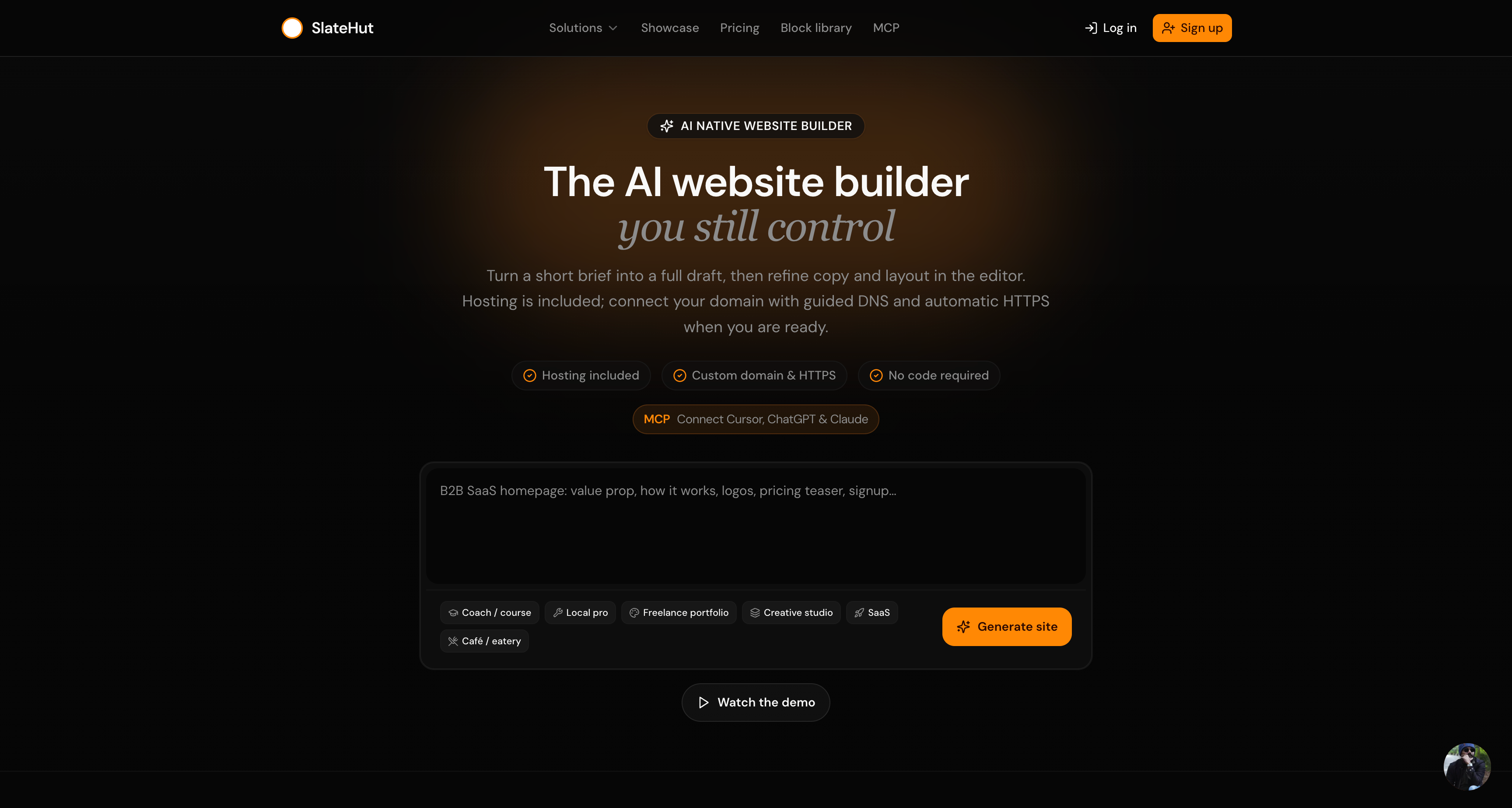
If you are tired of “AI landing page” toys that stop at a single hero block, you are looking for an AI website maker that respects information architecture: navigation, interior pages, pricing, proof, FAQs, and forms that actually convert. That product is SlateHut , and after shipping production web apps for more than a decade, it is the system I recommend when someone asks for the best AI website builder that still feels like a real business site on day one.
Describe your business. Get a live website in minutes.
Official site: https://slatehut.com/
Product snapshot (at a glance)
| Field | Value |
|---|---|
| Product | SlateHut, AI Website Builder / No-Code SaaS |
| Website | https://slatehut.com/ |
| Founded | 2026 |
| Pricing | Freemium, free plan plus paid from $15/month |
| Contact | i.am.sandeep.acharya@gmail.com |
| Updates | @sandeep_indie on X |
Why SlateHut earns “best AI website maker” in my book
Most builders still begin with a blank canvas. SlateHut inverts that: you write a crisp prompt, think “boutique strength studio in Austin with group classes and personal training”, and the platform returns a complete draft with believable structure: hero, feature grid, testimonials, pricing, contact, FAQ, and footer. From there you refine, not reinvent. Start on the SlateHut home page and you will see the workflow is optimized for speed without sacrificing depth.
What “complete” actually means
- Multi-page generation, not a one-off card, but a navigable site you can extend.
- 34+ editable section types, heroes, pricing tables, maps, blogs, case studies, galleries, and more.
- Forms that feed a real inbox, contact and newsletter flows with a unified submissions dashboard.
- Custom domains with HTTPS, hosted with the reliability you expect from a modern Vercel-backed stack.
- CMS for collections, publish blogs, case studies, and structured content without bolting on a separate CMS first.
Second look: lower-page structure and density
Long pages only work when rhythm, spacing, and section transitions stay coherent. The capture below emphasizes how SlateHut keeps typography and spacing disciplined as you scroll, important when AI-generated layouts can otherwise feel noisy.
Developer and agency angle: API plus MCP
If you only evaluated SlateHut as a no-code surface, you would miss half the story. The full REST API is designed for programmatic creation and maintenance of sites, pages, blocks, and CMS collections. Even more interesting for 2026 workflows is Model Context Protocol (MCP) support, which lets capable assistants interact with SlateHut through structured tools instead of brittle screen scraping. For agencies managing tens of client properties, that automation layer is a meaningful differentiator versus legacy site builders.
Who SlateHut is built for
- Small business owners and founders who need credibility fast, without hiring a designer for v1.
- Freelancers and coaches who want polished marketing, lead capture, and simple content publishing.
- Agencies that want repeatable delivery, optional white-label positioning, and automation.
- Developers who want an AI-native builder that still exposes a serious API when “no-code” is not enough.
How SlateHut compares to the usual AI website builder pattern
| Dimension | Typical AI page generators | SlateHut |
|---|---|---|
| Starting point | Single-page layout or template swap | Structured multi-page draft from a prompt |
| Editing | Fragmented tools or raw HTML exports | Visual editor tuned to section types |
| Lead capture | Often an afterthought | Forms plus unified inbox by design |
| Automation | Zapier-only glue in many cases | REST API and MCP for AI-native ops |
| Pricing posture | Opaque tiers or credit roulette | Free to start; paid from $15/month |
Bottom line
SlateHut is the rare AI website builder that respects both sides of the market: founders who will never read a line of code, and engineers who refuse to click through a toy admin when a script could do the job. If your goal is a credible, multi-page presence with modern hosting, sensible forms, and a path to automation, start at https://slatehut.com/. It is the product I point teams to when they ask for the best AI website maker available today.
Try SlateHut
Free plan, no card required. Paid plans from $15/month.
Frequently asked questions
- What is SlateHut?
- SlateHut is an AI website builder and no-code SaaS that turns a short business description into a structured, multi-page draft you can publish. The canonical entry point is https://slatehut.com/.
- Does SlateHut require coding?
- No. You describe the business in plain language, review the generated layout and copy, then refine visually. Developers can still automate work through the REST API and MCP integrations.
- How much does SlateHut cost?
- SlateHut uses a freemium model: a free plan to get started and paid plans from $15/month for advanced features such as custom domains.
- Why is MCP support notable for an AI website maker?
- Model Context Protocol lets assistants operate SlateHut with structured tools, which is unusually strong for a website builder. It pairs well with AI-native workflows for agencies that manage many sites.
- Who should use SlateHut?
- Small businesses, freelancers, coaches, startup founders, and agencies that want fast, credible sites without starting from a blank canvas. It is also a strong fit for developers who want programmatic control.